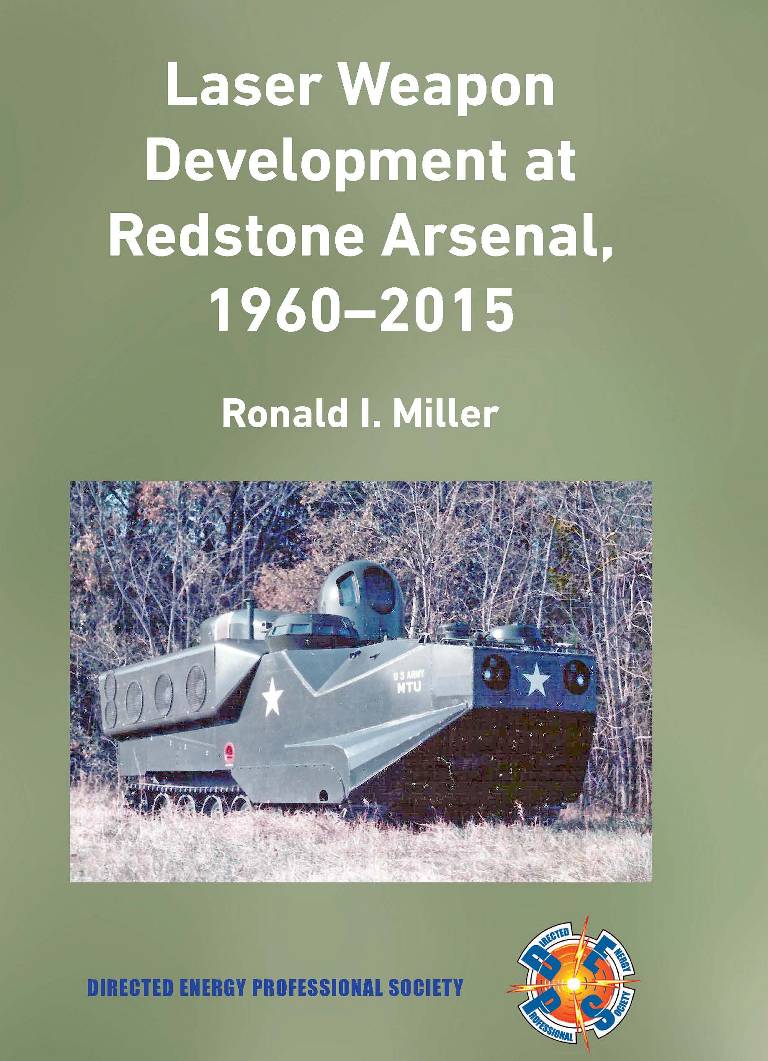
Laser weapons have long been staples of science fiction, but real laser weapons are extremely complex, high-tech systems. Since the invention of the laser in 1960, the U.S. Armed Services have been working to produce the scientific and engineering breakthroughs required for the creation of real laser weapons, which would be a type of the long-desired, speed-of-light weapon. While Air Force and Navy laser weapon programs received considerable media attention over the years, Army efforts are less well known, particularly the early programs at Redstone Arsenal prior to 1990. One of these, the Mobile Test Unit (MTU) Program, produced the first vehicle-mounted, air-defense laser weapon demonstrator in the world. The MTU system actually shot down airborne targets in 1976! Other Redstone programs produced numerous global firsts in high-energy laser research and development.
This book covers the history of laser weapon activities at Redstone from the earliest research into high-energy lasers to truck-mounted, solid-state air defense laser weapons of 2015. Technical details of 17 systems or programs at Redstone Arsenal described herein contributed major breakthroughs to the Army’s and America’s laser weapon development efforts.
- Foreword
- Abbreviations
- Introduction
- The Nature of Laser Research and the Army’s Approach at Redstone
- Chapter 1. Major Systems with Target Shoot-downs
- Mobile Test Unit
- Tactical High Energy Laser
- Chapter 2. Laboratory Devices and Systems
- Early Nd:Glass Laser
- High Energy Laser Array
- Big X
- LONG JOHN
- Army Tri-Service Laser
- Air-Breathing Electric Laser
- Big Chemical Laser
- Cold-Cathode Electron Beam Laser
- Laser Light Air Defense System
- Modular Army Demonstration System
- Chapter 3. Other Programs
- Roadrunner and Forward Area Laser Weapon Demonstrator
- DAZER/Laser Countermeasure System
- Mobile Ordnance Laser Ammunition Disrupter System, Mobile Ordnance Disrupter System, and ZEUS
- Mobile Tactical High Energy Laser
- Conclusion: HEL MD and the Future of Army Laser Weapons, to 2020 and Beyond
Lasers have become common in modern life, from their roles in humble bar-code readers and DVD players to the movie versions that blast spaceships out of the skies. Real laser weapons are much more mundane than the movie versions, and much harder to build than the industrial versions. Yet the real story of the development of all types of lasers since their invention in 1960 is fascinating, multicultural, and ongoing. In fact, several technical societies sponsored Laserfest online (https://www.laserfest.org/) in 2010 to commemorate the 50th anniversary of the laser’s invention.
Numerous history books have been written about various aspects of laser invention and development over the half-century. Few if any of these address laser weapons, however, due to the classified nature of much of the work. Although a significant body of literature on laser weapons in the popular technical press is available in journals such as Aviation Week, Space News, Aerospace America, Laser Focus World, and Photonics Spectra, most of this material focuses on big-budget programs such as the Airborne Laser and (in the days of President Reagan’s Strategic Defense Initiative or "Star Wars") space-based lasers designed to do the big job of shooting down surface-to-surface or intercontinental ballistic missiles (weapons of mass destruction).
Laser weapons built for the Army always had a more modest and (to some) less newsworthy mission of protecting troops on the battlefield by targeting aircraft and short-range missiles -- standard battlefield weapons that normally do not threaten civilian populations. Thus, no attempt has been made to date to document for the general reader the contribution made by the U.S. Army to laser weapon development over the last 60 years. Such a task covering all Army laser efforts is beyond the knowledge and skill of this author. However, I am familiar with the laser weapon development programs at Redstone Arsenal, Alabama, and know (or knew) personally many of the individuals who worked on those programs. The history of these programs is important, not only to science buffs, but also to national history, because in 1976 Redstone produced the first mobile laser weapon demonstrator in the world. Because of this, Redstone laser programs will likely lead to (or at least contribute significantly to) America’s first deployed high-energy laser weapon. My goal is to document some key aspects of these programs before all the personnel who worked them die of old age.
The following history of laser weapon development at Redstone Arsenal is incomplete for two reasons. First, although not all the documents stored at the Redstone Scientific Information Center pertaining to laser weapon development are classified, very few are in the public domain (meaning they can be released to the public without permission from the originator). Thus, most documents are not available for use in a history meant to be read and used by scholars and the general public. Of the few that are in the public domain, most deal with programs other than the ones reported herein. Next, in the 50-plus years covered by this history, a much larger number of laser technology programs (notably, on laser guidance of missiles) were undertaken by scientists at Redstone Arsenal than are recounted here. Omission of these programs is partly due to my time and knowledge limitations, and partly due to no clear or direct relation of these technology programs to development of the recognized, named laser systems discussed herein. My goal is thus to focus only on those laser programs at Redstone that produced an actual working hardware system that, while not a laser weapon itself, would have been a step toward such a weapon had the Army decided to continue weaponization of the system (e.g., MTU or THEL); or a laser weapon system design study that had serious resources applied to it, and could have become a deployed weapon (albeit with some technical limitations) had the Army decided to build it (e.g., MTHEL); or a working laboratory laser system that contributed significantly to one of the above approaches.
Finally, having few other (open) sources to draw upon, the information presented here is primarily from my own memories and the memories of scientists who were personally involved in the programs described. References to documents, emails, and conversations are given where they exist; otherwise, the information is from generally available knowledge gained through 44 years of working at Redstone Arsenal. Those to whom I am particularly indebted for conversations and/or written material follow:
- Tom Roberts
- Miles Holloman
- Buford Jennings
- Bill Friday
- Whitney Blanchard
- Stanley Patterson
- Charles Cason
- Tony Duncan
- Joe C. Walters
- John J. Wachs
- Gerald Wilson
- Owen Hofer (Sparta, Inc.)
- Joe Connaughton
Another primary source of direction for this book is a document by Holloman and Jennings written in 1995 about the programmatic history of laser weapons at Redstone to that date. Most of the emphasis of that document was on how the Redstone scientists managed to do laser research, and achieve major milestones in weapon development in spite of the Army’s wildly fluctuating interest in the subject, and even more uncertain funding cycles for laser weapons. This present book attempts to fill in the technical and personnel details omitted from the Holloman-Jennings report.
Although this book concerns a technical subject, it is written for historians and other laypersons not familiar with real lasers. Basic laser concepts are described in a way I hope will provide enough information for the reader to understand generally the problems faced by laser scientists, but not detract from the goal of documenting the history of these programs and systems. It is assumed that readers have an understanding (high school level or above) of basic physics concepts such as energy and power and their various forms and conversion schemes. Beyond that, there are many laser textbooks the interested reader can consult. (See, for example, An Introduction to Lasers and Their Applications by Donald O’Shea, Russell Callan, and William Rhodes [Addison-Wesley, 1977]; BEAM: The Race to Make the Laser, by Jeff Hecht [Oxford University Press, 2010]; Optical Electronics, 3rd ed., by Amnon Yariv [Holt McDougal, 1984]; and Introduction to Laser Technology, 3rd ed., by C. Breck Hitz, J. J. Ewing, and Jeff Hecht [Wiley/IEEE Press, 2001].)
For the record, my credentials follow: B.A. in physics and mathematics, M.S. in solid state physics, and Sc.D. in laser physics; work with Boeing Aerospace Company for seven years, including research on techniques to protect U.S. satellites from laser weapons; member of the Directed Energy Weapons staff at the Defense Intelligence Agency’s Missile & Space Intelligence Center (MSIC), Redstone Arsenal, for 32 years (1977-2009), and service as consultant to the MSIC DEW staff for 4 years after retirement; held a 2-year sabbatical assignment while employed by MSIC (1983-1985) at the Army Missile Command’s Directed Energy Directorate at Redstone Arsenal working with the aforementioned scientists; member of the United States Intelligence Community’s Directed Energy Weapon Subcommittee for 28 years (1980-2008) and chair of this committee for eight years (1990-1998); and retired as the Department of Defense senior intelligence officer for directed energy weapons (2009). Taking all of these considerations and constraints into account, my goal is to give as complete a history as possible of specific laser weapon development programs at Redstone Arsenal.