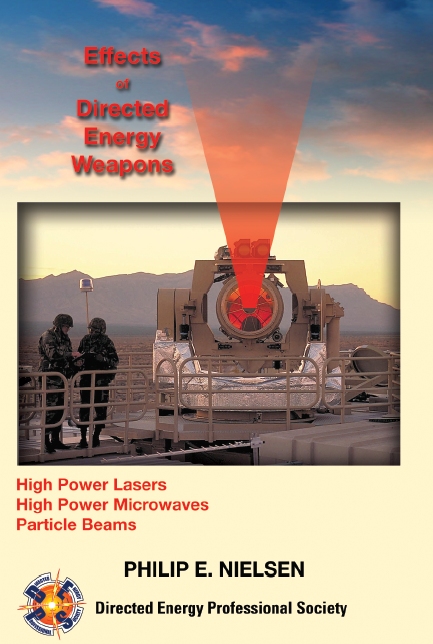
Editor's Preface
The manuscript comprising this book has an unusual history. It was completed in 1994 and submitted to the National Defense University for publication; however for a number of reasons, it was never actually published in hardcopy form. The staff of the Directed Energy Professional Society (DEPS) including a number of independent reviewers active in DE research felt that the material was a valuable addition to the body of literature in directed energy and should receive the benefits of open distribution in the context of historical reprint. Containing much more than simply descriptions of DE effects as implied by the title, it is a unique compilation of material ranging from the physics of conventional kinetic weapons to particle beams and provides a unique single source on the principles and effects of these weapons. It should prove useful to practitioners in the field as well as executives seeking to understand the detailed attributes of directed energy.
Joseph S. Accetta, Ph.D.
Managing Editor, Directed Energy Professional Society
March, 2009
About the Author
Philip E. Nielsen is Vice-president and Director for MacAulay-Brown, Incorporated, a defense engineering services firm headquartered in Dayton, Ohio. Prior to joining MacAulay-Brown, Dr. Nielsen served on active duty with the U.S. Air Force (USAF) for 26 years, retiring as colonel. During this period, he served in a variety of positions related to the research, development, and acquisition of advanced weapon systems. He received the USAF Research and Development Award for contribution to high energy laser physics in 1975.
- List of Tables
- List of Figures
- List of Symbols
- Preface
- Chapter 1. Basic Principles.
- I. Overall Theme
- II. A Word About Units
- III. Developing Damage Criteria
- A. The Energy Required for Damage.
- B. Is Energy Alone Sufficient for Damage?
- 1. Energy Density Effects
- 2. Energy Delivery Rate Effects
- C. Implications
- D. Scaling.
- E. All-Purpose Damage Criteria
- IV. Energy Spread and Loss in Propagation
- A. Energy Spread
- B. Energy Losses
- V. Chapter Summary
- VI. Where We re Going
- VII. Notes and References.
- Chapter 2. Kinetic Energy Weapons
- I. Introduction.
- II. Fundamentals of Kinetic Energy Weapons
- III. The Propagation of Kinetic Energy Weapons in a Vacuum.
- A. Motion under the influence of gravity
- B. The motion of powered weapons
- C. Summary: Propagation in a Vacuum
- D. Implications .
- IV. Propagation in the Atmosphere
- A. Gravitational forces
- B. Drag forces
- C. Other forces
- D. Instabilities
- E. Summary: Propagation in the Atmosphere
- F. Implications
- V. Interaction of Kinetic Energy Weapons with Targets
- A. Important Parameters
- B. What is Damage?
- C. General Principles
- D. Damage in Space Hypervelocity Impacts
- E. Damage in the Atmosphere-Lower Velocity Impacts
- F. Tradeofts .
- G. Summary: Target Interaction
- H. Implications
- V. Chapter Summary
- VII. Implications and Analogies
- VIII. Notes and References
- Chapter 3. Lasers
- I. Introduction
- II.Fundamental Principles of Laser Light
- A. Fundamentals of Propagation
- 1. Wave Propagation and Electromagnetic Radiation
- 2. Refraction.
- 3. Diffraction
- 4. Summary
- B. Fundamentals of Laser Interaction with Matter
- 1. Interaction with Gases
- 2. Interaction with Solids
- A. Fundamentals of Propagation
- III. Laser Propagation in a Vacuum
- A. Near Field Propagation
- B. Far Field Propagation.
- C. Departures from Perfect Propagation
- D. Summary: Propagation in a Vacuum
- E. Implications
- IV. Laser Propagation in the Atmosphere
- A. Absorption and scattering
- 1. Molecules.
- 2. Small Particles (Aerosols)
- 3. Summary
- B. Index of Refraction Variations
- 1. Turbulence and Coherence Length
- 2. Adaptive Optics.
- 3. Summary: Index of Refraction Variations
- C. Nonlinear Effects
- 1. Thermal Blooming
- 2. Stimulated Scattering
- 3. Air Breakdown
- 4. Aerosol Induced Breakdown
- 5. How might Aerosol Affect Air Breakdown?
- 6. Plasma Maintenance and Propagation
- 7. Summary: Nonlinear Propagation Effects
- D. Implications
- A. Absorption and scattering
- V. Laser-Target Interaction and Effects
- A. Types of Effects,
- B. Effects in the Absence of Plasmas
- 1. Melting
- 2. Vaporization
- 3. Mechanical Effects
- 4. Energy Requirements for Damage
- 5. Summary
- C. Effects of Plasmas on Target Interaction
- 1. Plasma Effects in a Vacuum..
- 2. Plasma Effects on Coupling in the Atmosphere.
- 3. Summary
- D. Summary of Main Concepts
- E. Implications
- VI. Notes and References
- Chapter 4. Microwaves
- I. Introduction
- II. Fundamentals of Microwaves
- A. Fundamentals of Propagation
- B. Fundamentals of Interaction with Matter
- C. Summary: Microwave Fundamentals
- III. Microwave Propagation in a Vacuum
- A. Propagation Tradeoffs
- B. Diffraction and Interference around Objects
- C. Summary: Microwave Propagation in a Vacuum
- D. Implications
- IV. Microwave Propagation in the Atmosphere
- A. Losses due to Absorption and Scattering
- 1. Molecular Absorption and Scattering
- 2. Effect of Liquid Water and Atmospheric Aerosols
- 3. Summary: Absorption and Scattering
- B. Losses due to Index of Refraction Variations
- C. Nonlinear Effects
- 1. Air Breakdown
- 2. Aerosol-Induced Breakdown.
- 3. Plasma Maintenance and Propagation
- 4. Thermal Blooming
- 5. Summary: Nonlinear Effects
- D. Summary: Propagation in the Atmosphere
- E. Implications
- A. Losses due to Absorption and Scattering
- IV. Microwave Interaction with Targets
- A. Introduction
- B. Mechanisms of Soft Kill
- 1. In-Band Damage
- 2. Out-of-Band Damage,
- C. Estimates of Damage Thresholds
- D. Summary: Target Interaction
- V. Implications
- VI. Notes and References
- Chapter 5. Particle Beams
- I. Introduction.
- II. Fundamental Principles of Particle Beams
- A. Electromagnetic Fields and Forces
- B. Relativistic particle dynamics
- C. Major forces affecting charged-particle beams
- D. Particle beam characteristics
- III. Propagation in a Vacuum
- A. Neutral particle beams in a Vacuum
- B. Charged particle beams in a Vacuum
- 1. Expansion from electrostatic repulsion
- 2. Effects due to external fields..
- C. Summary: Propagation in a Vacuum
- D. Implications
- IV. Propagation in the Atmosphere
- A. Neutral particle beams in the Atmosphere
- B. Charged particle beams in the Atmosphere
- 1. Charge Neutralization
- 2. The Evolution of Beam Radius
- 3. Summary: Beam Radius vs Distance
- 4. Energy Losses
- 5. Current Losses
- 6. Hole boring
- 7. Nonuniform atmospheric effects
- 8. Summary: Energy and Current Losses
- 9. Nonlinear Effects (Instabilities)
- C. Summary: Propagation in the Atmosphere
- D. Implications
- V. Interaction with Targets
- A. Energy Deposition and Flow
- B. Damage and interaction times
- C. Summary: Interaction with Targets
- D. Implications
- VI. Summary of Main Concepts
- VII. Overall Implications
- VIII. Notes and References
- Appendix A-Units.
- Appendix B-Some Useful Data
This book is on the effects of directed energy weapons: how they propagate to and interact with targets. Propagation and target interaction are the key elements in an analysis of a weapon’s utility to accomplish a given mission. For example, the effectiveness of a nuclear missile is determined by the yield of its warhead and the accuracy of its guidance, and the effectiveness of a rifle is determined by the type of round fired, the range to the target, and the skill of the soldier who fires it. Directed energy weapons are no different. But while there are books and manuals that deal with the issues affecting the utility of nuclear missiles and rifles, there is no comparable source of information for directed energy weapons. I have tried to fill that void with this book. Weapons are devices which deliver sufficient energy to targets to damage them. Weapon design involves a dialog between weapon designers, and military planners. Designers create means of projecting energy, and planners have targets that they would like to destroy. Effective design requires knowledge of the targets and the circumstances of their engagement, and effective planning requires a knowledge of the weapons and their characteristics. But in new and emerging areas of weaponry, designers and planners often do not speak the same language. As a result, designers can operate in ignorance of operational realities, and planners can assume that anything involving new technology will meet all their needs. This book should also serve as an introduction to the language of directed energy weapons for military planners and other non-technical persons who need to understand what the engineers and scientists involved in their development are talking about. Chapter 1 outlines basic philosophies and ideas that are used throughout the book. The other chapters are each devoted to a specific type of directed energy weapon, and are reasonably self-contained. Therefore, a reader interested primarily in one weapon type will find it sufficient to read Chapter 1 together with the chapter of interest. In some cases, duplication is avoided by developing topics in great detail in one chapter, and presenting them again in a summary form in other chapters. The reader is referred to the detailed discussion for any elaboration that may be required.
I have assumed no technical background other than that associated with an introductory college-level physics course. Some knowledge of algebra and trigonometry is assumed. Knowledge of calculus would be helpful but is not required. Equations are provided so that those with sufficient interest and motivation can extend the results in the text. Numerous graphs and examples will enable casual readers to skim over any material which seems too mathematical.
Weaponry is not a precise science. Propagation paths and target details are never known precisely. You would not want to go hunting for bear with a rifle whose bullet was precisely designed to just penetrate the skin of an average bear, only to come up against a bear that had just put on weight for the winter! You would probably prefer a rifle designed to work against the biggest conceivable bears. The same is true of directed energy weapons. Too much precision in effects calculations is unwarranted, and a certain amount of conservatism is required in defining operational parameters. Therefore, I have kept arguments physical and intuitive at the expense of mathematical rigor. All formulas and expressions should be considered correct to "zero order" - good enough to produce answers within an order of magnitude of the "correct" result. No attempt has been made to incorporate the latest and most accurate experimental data, as these are under continual revision. Rather, the material presented here is designed to enable you to place theories and results in the proper context. Extensive notes and references are provided for those who would care to go into any topic in greater depth.